Showing posts with label Summer Exhibition. Show all posts

Monday, 27 August 2012

Reflective Journal


Elaine Zhang
MA Graphic Design
Reflective Journal
Word count2333


In addition to the final show, there were lots of practice and development at MA level study. In the working process of this one-year study, I learnt and got much more from the projects, research, symposium, lecture and final work. It is no denying that criticality is a key characteristic of MA study; therefore, it is important to evaluate the development included how to solve the problems in progress, and what have been changed from the study proposal. It’s also an internal consistency between the practice and the future development.

Firstly, the initial interested area of my study proposal was about the urban people’s concealed and missing emotion. In view of existing situation of modern people, I wanted to explore the idea of the mentality of urbanites, and pay attention to the strange, lonesome or vacuous emotions, which are cased by the tremendous work pressure. As for the specific interested orientations, there were some tentative ideas to consider, such as the numb attitude of office worker. It can be seen that my original idea was to express the theme from the urban person’s perspective. In addition, I carried on my previous projects related to this theme such as the silent film “Lost in life” (image 1&2), which was showed at Sigune’s studio. In this project, I focused on the lonesome, isolated and insensitive emotion of a girl who is eager for playing a close game with a friend. I used a hand game as an element to run my ideas. In fact, this is a traditional Chinese game that should be played with two persons, but they were just one girl who played the game and repeated the same action by herself in my video and book. Besides, audience could play game with the girl, which is a participation and interaction between the work and the viewers. When the film was showed in the public screen, I thought the visual language is strong, but the quality was vague. After that, I retook the video as high- quality photographs and did a book in the artist book workshop, which was showed in the “work in progress” exhibition. (Image 3)

Secondly, at the start point of my main project, I used masks to express urbanites' surface emotion, which is ostensible and unreal. I thought that lots of people ignore what they want, lose happiness and miss their emotion. In addition, they use an invisible mask to conceal their emotion in this complex and stressful social condition. As a result, I used mask to carry on an installation. In the progress, I broke the "surface masks", strung and hung up them (Image 4.). The chips of the masks looked sad and vacuous in the swinging state. In addition to the installation, I also thought about to take a video that refers to the city life, and then use projection to show the images in the masks. To evaluate the test, it was good to extend the methods and materials to do installation with marks; however, the element “mask” was vulgar and commonplace to express the idea. Importantly, other artists have used masks frequently, which is also hard to break through the first impression about the meaning of opera. In fact, after I gave up the mask idea, I saw Gillian Wearing’s exhibition at Whitechapel Gallery, which had a really strong method and vision to show the concealed emotion. Wearing questions how much we can determine about individual’s personality by looking at a person’s face and facial expressions. Her masks are liberating in a sense, because they allow people to say what they want, and not what others want them to say. Even though I did not continue the mask idea, Wearing’s work still gave me lots of inspiration.  

At this stage, I researched lots of related artists’ works especially the installation and space design. In particular, Esther Stocker makes great contribution to the disorientation of space. She is good at using black and white geometric patterns to create visual interactive space and make a real space as a large installation for viewer’s participation. In her trippy 3-D installations, Stocker's large architectural forms like real-life, 3-D optical illusion. Importantly, most of her works allow the visitors to interact and absorb the environmental space; therefore, she offers a close space for participation. After the researches, I tried to make models to create an illusion of the fickle city life, which was inspired by Stocker’s works. It can be seen that my proposal has been a little bit changed in the expressive point of the theme. Through the abundant researches, I am going to express the stressful and oppressive urban life by the expression of the living environment and condition. That means I want to express the urban people’s emotion from their outside instead of human itself.

Specifically, for the ideas about installation of models, I tried different materials to create visual effects refers to a disorientation of urban life in a model of space. For example (image 5), I used illustration of buildings to extend the ideas. The tier upon tier of buildings, which reflected a stressful and busy urban life, created this installation. In this model, I drew the buildings on the floor and wall, especially; I built a reflected image of buildings on the floor that looked like a mirror. It can be imagined that viewers will feel stressful and oppressive when they come into the space, and let them to think about their life in the busy city. In addition, I tested other materials that ware film and mirror paper. (Image 6 & 7) As I mentioned, city life is colorful and full of false appearance, which like the illusion of mirror. I used the colorful film and mirror papers, and reflected light to build an illusion space. The mixed colour materials created an illusion that just like a complex and fickle city life. As a consequence, when people walk in the space, they can see themselves vaguely because of the mirror effect, just like they miss the emotion of themselves by the complex and fickle city life.  At this stage, I was really interested in doing the models; however, the problem is the infeasibility. Those models were difficult to realize in a real space because of the high price of materials and technology.

So I tried to find a feasible way to realize my idea. There were two different ways that I tested for realizing the models into a real space. The first idea was to draw the illustration of the buildings in a large roll of paper which about the size “2m*10m”. (Image 8) It can be seen that viewers can enter the large installation to experience the effect. Even through the large-scale drawing could be realized by working with the fact that it is on a paper roll, the effect was not as powerful as which I want to have.

Through a lot of research about installation and space work from related artists’ works, I tried to think the specific emotions of urban people. And I found all my ideas were my own thinking and feeling, not the attitude or thinking from the specific people who living in London around us. As a foreigner, I cannot understand British people’s thinking because of the different culture and society. So I did interviews and tried to know the area specifically. (Image 9) And I want to know how people think about their life in a large city and what’s the different between china and here. Through the interviews, I got a lot of information from different people who working here or come from other countries. Most of them feel stressful, lonely, unhappy or busy to their work or study. And some people feel the pressure must be happened with the rapid development of society, but we need to face the stress and make our psychology to be better. I was interested in interviewing people, and it was a good way to get more ideas by different specific questions. In fact, the idea of interview was inspirited from the Jessica project, which was the first project with Silke in the first term. (Image 10) If I want to extend the idea of interview, how to open up the interview question will be the point that should be concerned in the future.

After the interviews, I tested other visual effect to create a illusion or disorientation of an urban life, but the problem was the drawing of the buildings were not suitable to express my idea, because it was not real city life. So after that, I took photos around the city, and choose modern buildings as the element. Besides, I edit a small video and projected it to the colourful papers to create a fickle word. On the other hand, I tested the effect by using the projector in the private area. I projected the image in the place, which I am living. For urbanities, the home is close and private and makes people relaxed, but I moved the stressful situation to their private space to create a stressful and oppressive atmosphere. (Image 11 & 12)

At the end of the MA study, final exhibition is the most important project, which has already token a long time to develop the ideas. When I started to think about the expression of summer exhibition, I preferred to carry on my project with the idea of projecting work, which referred to the photos I took in a private space by projecting the city images. However, After the final show presentation, I faced a question that I just thought about to use public image into a private space which was a way to make the outside stresses to contrast with the inside individual private space. But I had not concerned that if I want to show this visual work into an exhibition space, it becomes another way to make the private back to a public space and the meaning will be changed. That was the big problem made me confused, but on the other side, it also made me to think about my work from a new point of view. 

To solve the problem, I rethought about the model practice and tried to extend the ideas and realize it to a 3D space. Importantly, installation and space work are still my most interested area. As I mentioned, disorientation of the urban life is also the theme I want to show, and the fickle and stressful atmosphere is what I want to create in an interactive exhibition space. Through the test, I decided to create a mirror effect that will be like an illusion of urban life. In my work, I am exploring the stressful and fickle nature of the urban life and it's suppression of its inhabitants' emotion. My approach is to create a participatory space with a mirroring effect, with relevant themes to contemporary society. Here I am acknowledging that urban life develops rapidly, and that there are numerous pressures, like work and living situations, that make inhabitants feel lonely, discouraged, oppressed, and passive. I'm trying to make the stressful nature of the urban environment visible to the public. Additionally, my interest for 3D graphics and participatory design are clearly exhibited in this installation. The experience of models was an important step in my development. I extended my ideas and methods to a new stage, and got to know what area I really interested. As a result, some practice and test will give you a useful development. In fact, during the final project, Mona Hatoum’s work gave me a lot of inspiration. I visited the The Fundació Joan Miró in Barcelona recently, and it was really fortunate to see the British artist Mona Hatoum's work. The exhibition looked like a dialogue with avant-garde movements in modern art, which affected me to think about how to use a real space to make sense.

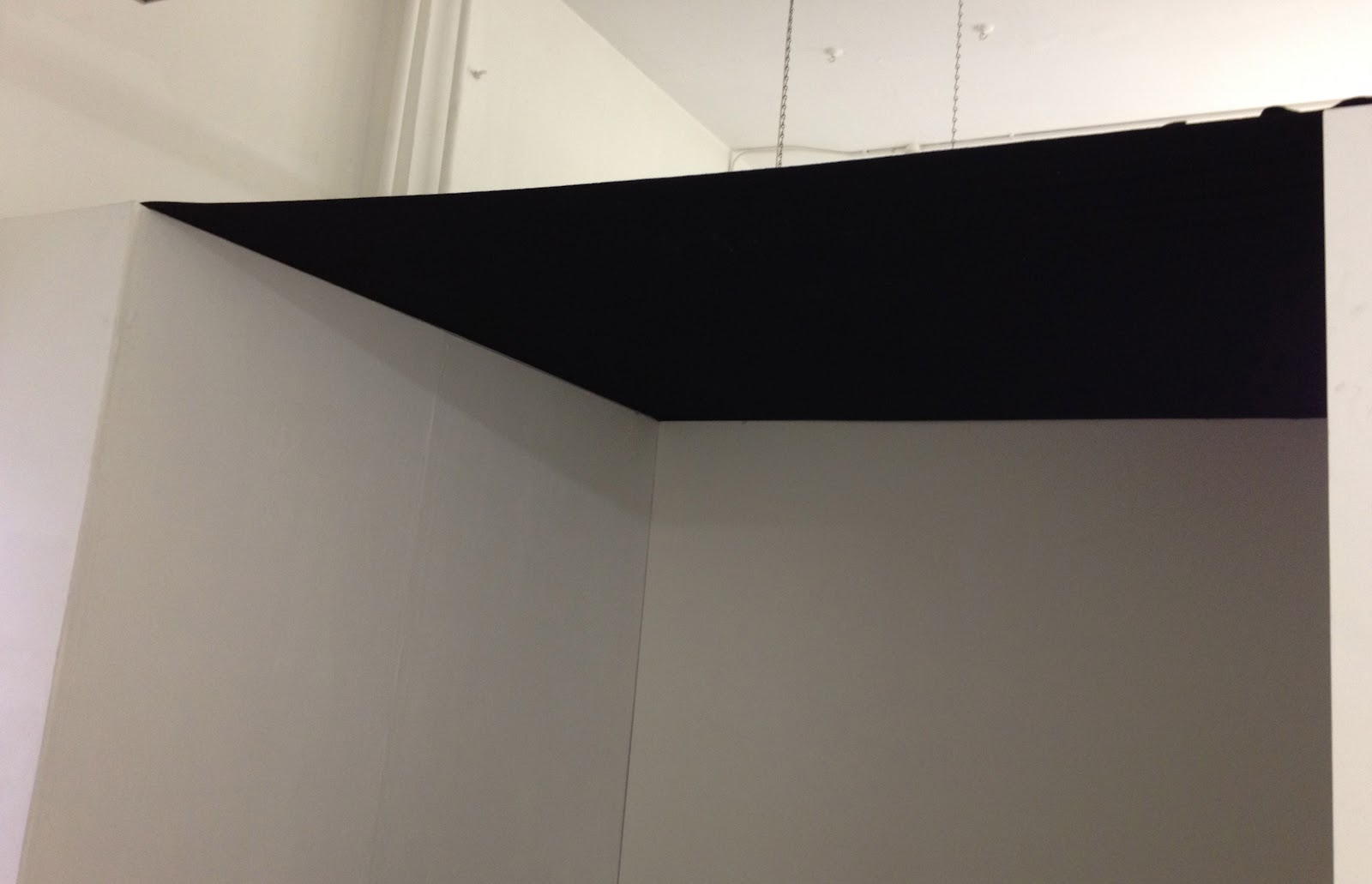
After distributing the exhibition space, it was time to decorate own area and adjust the situation, at the same time, the problems happened soon. For example, after fixing up the blackout material, it was installed loosely and looked not as professional as a gallery space. As tutors' suggestion, to solve the problem, it's better to swap the space with Chris. I have thought about it, but for me, changing space will be harder to realize my installation, because I need to place the projectors at the end of the opposite wall in the original space, which takes more than 3 meters away. If I move into a new space, it takes more time to reconsider the situation and material especially the mirrors. So I came to the space to remove the blackout material and re-installed it from another side by myself. It can be seen that it's very strict now. After that I took off the light tubes that I don't need, and left one light for Melis. Than the problem of light was also solved. By the way, I whitewashed the wall that I want to put my projectors. The process of setting up the exhibition was a useful and important part for the future self-development.

During the show build, I have arranged the mirrors for a long time. At first, I put the mirrors on the floor and tried to make an illusion; however, the big problem was that it would be very dangerous for viewers to stand inside. (Image 14) So I changed my mind to make a grid on the walls. Then I set up the mirrors as the Picasso pattern and made the mirrors looked like the building’s windows that showed in the video. As a result, the problem of safety is solved; the patterns are more corresponding, and the visual effect is still disorientation. (Image 15)

All in all, I learn a lot of things and become more confident during the development of MA level study. Importantly, I get to know what I really want to do in the future.


Invite viewers into the space


After solved the problems, the shadows are working in the space when viewers walk through in front of the projectors.The mirrors and their reflection have a nice connection with the building's windows in my video. Now I am happy with the effect that very "disorientation".


Schedule for the final work


Tuesday, 21 August 2012

To solve the problem


After adjusting the mirrors, the two important problems have been solved. One is the safety of mirrors on the floor. My original idea was to set up the mirrors on the floor, which I want to create a reflective mirror effect in the 3D space. But the safety was worried by tutors and college will not allow me to do this. I was suggested to remove all the mirrors. In fact, for me, it was a big challenge to change the idea to rearrange the mirrors because I adjusted the mirrors and projectors for a long time to arrive this step. But  I know that the changes and problems always happened before the last minute of final show. I rethought about the method and tried to give up the idea that put the mirrors on floor. Finally, I set up the mirrors on the walls that also like Picasso Pattern. When viewers enter the space, there are different effect with shadows happened. 


Thursday, 16 August 2012

Work in Progress- Final show


I rethought about the model practice and tried to extend the ideas and realize it to a 3D space. Importantly, installation and space work are still my most interested area. As I mentioned, disorientation of the urban life is also the theme I want to show, and the fickle and stressful atmosphere is what I want to create in an interactive exhibition space. Through the test, I decided to create a mirror effect that will be like an illusion of urban life. In my work, I am exploring the stressful and fickle nature of the urban life and it's suppression of its inhabitants' emotion. My approach is to create a participatory space with a mirroring effect, with relevant themes to contemporary society. Here I am acknowledging that urban life develops rapidly, and that there are numerous pressures, like work and living situations, that make inhabitants feel lonely, discouraged, oppressed, and passive. I'm trying to make the stressful nature of the urban environment visible to the public. Additionally, my interest for 3D graphics and participatory design are clearly exhibited in this installation. The experience of models was an important step in my development. I extended my ideas and methods to a new stage, and got to know what area I really interested. As a result, some practice and test will give you a useful development.


Wednesday, 15 August 2012

Work in Progress-problem with situation

At the first, the black-out material was installed loosely and looked not as professional as a gallery space. As tutors' suggestion, to solve the problem, it's better to swap the space with Chris. I have thought about it, but for me, changing space will be more hard to realise my installation, because I need to place the projectors at the end of the opposite wall in the original space, which takes more than 3 metres away. If I move into a new space, it takes more time to reconsider the situation and material especially the mirrors. So I came to the space to remove the black-out material and re-installed it from another side by myself. It can be seen that it's very strict now. After that I took off the light tubes which I don't need, and left one light for Melis. Than the problem of light was also solved. By the way, I whitewashed the wall which I want to put my projectors. Everything looks good, and I am happy with the situation now. It's time to set up the mirrors for the next step.


Saturday, 11 August 2012

for the MA Graphic Design Catalogue


-Title of work (project title): Disorientation of Urban Life


-Subtitle for photo (work photo title): mirror effect of stressful life in a participatory space.

-100 words text:
My work was to explore the stressful and fickle modern city and the suppression of emotion in urban life. The way of expression was to create mirror effect in a participatory space. Generally, the theme is highly relevant to contemporary society. It is acknowledged that in modern city, everything are developed fast, and there are a lot of pressures in urban life, such as individual ‘s work, study and living statement, which make them feel lonely, discouraged, oppressive and passive. In my final show, I tried to make the stressful city visible to the public. There was my interest for 3D graphics and participatory design; especially the visual works in an exhibition space.


Saturday, 4 August 2012

Written Paper


Elaine Zhang
MA Graphic Design
Written Paper
Words count: 529

At the end of MA study, in addition to the final show, it is significantly necessary to summarize the statement about current practice and to think about the future longer-term goals; therefore, I analyze and reflect these two parts in this written paper.

Looking back at the past, firstly I got to know my interested field clearly in the process of the self-development and did more practices. Generally, my work was to explore the stressful and fickle modern life and the suppression of emotion in urban life. In addition to the theme of my project, I am really interested in participatory art and space design, which was mentioned as key point in my study proposal and research paper. Specifically, my research and practice area was about the interaction between graphic language and the participation of audience in the organization of space. In the process, I extended my ideas by using models and installation and projecting into real private space, which all related to the ways to create ‘atmosphere’ in a particular setting. I tested different ways and tried to make my ideas visible to the public. Besides, it was inevitable to encounter problems, for example, how to realize my models in visual form and how to make viewers to experience the visual effect. In particular, after the final show presentation, I faced a question that I just thought about to use public image into a private space which was a way to make the outside stresses to contrast with the inside individual private space. However, I had not concerned that if I want to show this visual work into an exhibition space, it becomes another way to make the private back to a public space and the meaning will be changed. That was the big problem made me confused, but on the other side, it also made me to think about my work from a new point of view. To solve the problem, I will just print the private space photos as a book, rather than project it into a public space. Meanwhile, I still keep developing the idea about space experience and try to create a stressful and giddy effect by using mirrors and projection, which will be showed in the final exhibition.

Looking forward to the future, I get to know what I really want to do from MA study because of the practice and development, which were closed to installation, 3D work or participatory design in a public space. How to create the connection between the artist’s work and the viewers is a question I often concerned, so I am really interested in the participation and interaction work in gallery space, which was showed evidently from my practices and final work. As a result, after graduation, I want to do the work related to this field, such as curator, which could be worked in a gallery space and do some works related exhibition planning.

All in all, I learnt much from the MA study, found out the defect that should be concerned in the future development and got to know what area I actually interested in and what kind of profession I want to choose.


Tuesday, 10 July 2012

Final show presentation

After the final show presentation, I faced a question that I just thought about to use public image into a private space which was a way to make the outside stresses to contrast with the inside individual private space. However, I had not concerned that if I want to show this visual work into an exhibition space, it becomes another way to make the private back to a public space and the meaning will be changed. That was the big problem made me confused, but on the other side, it also made me to think about my work from a new point of view. 


Saturday, 30 June 2012

Starting point of final show and problems

At the end of the MA study, final exhibition is the most important project, which has already token a long time to develop the ideas. When I started to think about the expression of summer exhibition, I preferred to carry on my project with the idea of projecting work, which referred to the photos I took in a private space by projecting the city images. 


Sunday, 17 June 2012

Projecting the public image into private space

Here I tested the effect by using the projector in the private area. I projected the image in the place which I am living. For urbanities, the home is close and private and make people relaxed, but I move the stressful situation to their private space to create the stressful and oppressive atmosphere.


Sunday, 10 June 2012

Interview for urban people's idea about stressful life


Through a lot of research about installation and space work from related artists’ works, I tried to think the specific emotions of urban people. And I found all my ideas were my own thinking and feeling, not the attitude or thinking from the specific people who living in London around us. As a foreigner, I cannot understand British people’s thinking because of the different culture and society. So I did interviews and tried to know the area specifically.  And I want to know how people think about their life in a large city and what’s the different between china and here. Through the interviews, I got a lot of information from different people who working here or come from other countries. Most of them feel stressful, lonely, unhappy or busy to their work or study. And some people feel the pressure must be happened with the rapid development of society, but we need to face the stress and make our psychology to be better. I was interested in interviewing people, and it was a good way to get more ideas by different specific questions. In fact, the idea of interview was inspirited from the Jessica project, which was the first project with Silke in the first term.  If I want to extend the idea of interview, how to open up the interview question will be the point that should be concerned in the future.

Friday, 8 June 2012

Large-scale drawing test


By finishing half of the installation work, I found the drawing of the tier upon tier buildings was not good to show my idea. Because the drawing of buildings are not the really city. I need to find other way to create real image of urban city, which will be the point I want to express and it will be more powerful to be closed to viewers.


Monday, 7 May 2012

The ideas and sketch of my final show

I have done a lot of models for the development of my main peoject. Some of them I showed here, and some of them I did not showed in the blog. All the models were the process of the test and they were very helpful to extend the ideas. However, I want to develop the “building” one to carry on my final show in the future work.

There are two different ways that I try to test for realizing the models into a real space. The first idea is to draw the illustration of the buildings in a large papaer which about the size “2m*10m”. The roll of the papaer could be exhibited like the sketch. It can be seen that viewers can enter the large installation to feel the effect. In addition, another idea is to show the images of the buildings by projectors. There are some photos for testing, I am going to extend and develop the idea with more practices.


Sunday, 6 May 2012

STUDY PROPOSAL

STUDY PROPOSAL
----------------------------  Elaine (Yi Zhang) --- MA Graphic Design  ---------------------------

1)     RESEARCH QUESTION

The initial interested area of my study proposal was about the urban people’s concealed and missing emotion. In view of existing situation of modern people, I wanted to explore the idea of the mentality of urbanites, and pay attention to the strange, lonesome or vacuous emotions which are cased by the tremendous work pressure. That was the general direction. As for the specific interested orientations, there were some tentative ideas to consider, such as the numb attitude of office worker. It can be seen that my original idea was to express the theme from the urban person’s perspective; however, my proposal has been a little bit changed in the expressive point of the theme. Through the abundant researches, I am going to express the stressful and oppressive urban life by the expression of the living environment and condition. That means I want to express the urban people’s emotion from their outside instead of human itself. As a consequence, in the modern society, people ignore their real feeling and neglect what they really want to have from their inner heart. The missing emotion of urbanites is an interesting area which I want to carry on my project. Importantly, the way of expression from human outside area is my interested part. In particular, space design and participation design are the interesting areas which I want to combine with, and I am going to research how to realize a visual effect of my theme in a real space.

I think the theme of the project is relevant, because design should be concerned with social responsibility, which is the soul supporting a work. In my opinion, it’s less intensive and nothing remarkable if the work is created by a designer or artist who lacks social responsibility. We should broaden our horizons and see through the world. As a result, I think that researching urbanites’ emotion is a way to consider the modern people’s state of living, while it is also a viewpoint to concern the social phenomenon which has close relations to our life. Specifically, in my research content, ‘urban’ means a stressful, complex, lonesome and fickle life for modern people.

2) RESEARCH CONTEXT

As I mentioned above, I want to express urban people’s missing emotion from an outside perspective. Space design and participation design are the areas which inspired me a lot. Particularly, Kusama’s Endless Love Show gave me a lot of inspirations. When audiences stay in the space, the colourful and variegated colours make powerful attraction with the mirrored reflection. It is a special experiment for viewers because of the flicker effect, which is created by the phantasmagoric colours. Through the participation of the show, viewers are led into Kusama’s hallucinogenic word and made sense personally. Overall, it can be offered a close experience of face-to-face communication and participation by the diversified use of colours, just like the endless love happens to you.

Following this, I consider another famous artist Esther Stocker who also makes great contribution to the disorientation of space. There are a lot of related artworks designed by Esther Stocker, which successfully explain that how the interactivity of graphic language can be expressed in a gallery space. For instance, the minimal installation Abstract thought is a warm puppy, which is also made up of black geometric graphics and displayed in a white room spatially and optionally. As for the disorientation of the effect, the feeling of standing outside is different from entering inside. It can be seen that Stocker’s artworks have tremendous expressive qualities for expressing the interactivity between graphic language and the participation of viewers.

3) METHODOLOGY

There is my interest for 3D graphics and participatory design; especially the visual works in a real space, because the unpredictable effects will be happened in the process of audience’s participation. With the speedy development of graphic design, it is not merely used in 2-D form. Nowadays, graphic design is influenced by diverse areas of modern art, such as performance art, digital art, and participation art and so on. I am going to focus on the relationship between the using of graphic language and participation art in the organization of space. Large installation and space design will be the good ways to extend the idea. For the theme of my project, I plan to investigate particular area of London, explore the local residents’ lifestyle that contacts with my research.


4) RESOURCES
In the working progress, I am going to use photographic studio, printmaking studio and 3D workshop to carry on my work. But if I want to do large installation and space design, I will try to do some handmade models firstly, and test the different materials and visual effects in advance. In addition, college libraries and the different libraries in London are the important resources for researching. Besides, museums and galleries provide abundant information of artists’ art works for me to research.


Reference:
Cataldo, John W. (1966) Graphic design and visual communication. Scranton: International Textbook Co.
Collings, M. (1999) This is Modern Art. London: Weidenfeld & Nicolson
Frieling, R. (2008) The Art of Participation 1950 to New. London: Thames & Hudson Ltd.
Guglielmino, G. (2008) How to Look at Contemporary Art. New York: Umberto Allemandi & C Publishing.
Hoptman, L. & A. Tatehata & U. Kultermann, (2000) Yayoi Kusama. London: Phaidon Press Limited.
Newman, William M. (1995) Interactive system design. Harlow: Addison-Wesley.
Schadler-Saub, U. & A. Weyer, (2010) Theory and Practice in the Conservation of Modern and Contemporary Art. Hildessheim: Archetype Publications Ltd.